Finally, the Dyepot!

On a gorgeous Texas day in February (yes, we have those!), Arabella invited me over to learn some color dyeing techniques. She has a very high-tech operation going on in her kitchen:

Arabella's high-tech dye pot

Sometimes it’s nice to know that the practices from 10,000 years ago still work! Get a pot, get some water, get it hot, you can dye wool! Yes, that is a large aluminum mixing bowl set directly upon her electric stove burner, filled with water and roving. Do NOT boil the water, or you will end up doing something else that is 10,000 years old — Fulling. (You’ll have to click to get the rest of that story…)

The water should be hot, but not at all boiling or simmering. Add some vinegar. When I asked Arabella how much vinegar, she moved her hand as if she were pouring out vinegar from a bottle, and she said, “I put glug, glug, glug.” Classic instructions! (Good news: you can’t really go wrong. So glug, glug, glug, and you’ll be fine!)

So far we have roving
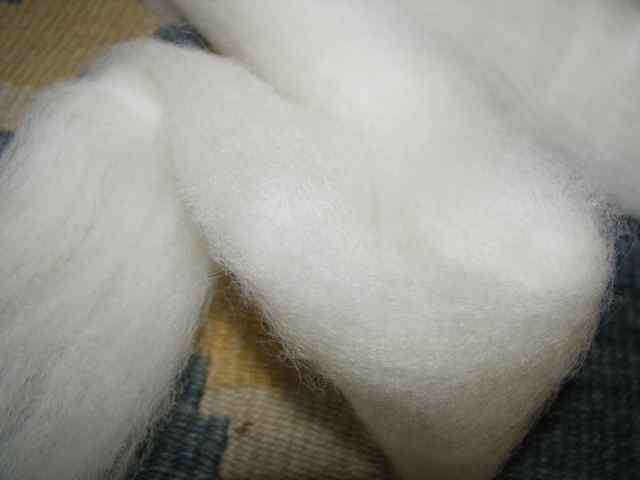
Roving ready to dye

we have the dye pot, some water, and some vinegar…..which makes delicious hot roving soup!

Soup, anyone?

Now we mix the dyes. We used Jacquard acid dyes. Mix the powder with water in a jar according to package directions.

Mixing the dye with water

Remember your color wheel from high school art class? It still works! We used our primary colors yellow, red and blue.

Add yellow...
A large syringe and a chopstick work perfectly!
Add red and blue...

With more high-tech tools such as a chopstick and syringe, add the dye and work it into the layers of roving by poking at them with the chopstick. You can also create additional colors by blending where the colors meet each other. Simply use the chopstick to move the roving a bit, adding more of whatever primary color you want to that area with the syringe. Stir a bit, and voila! new colors.
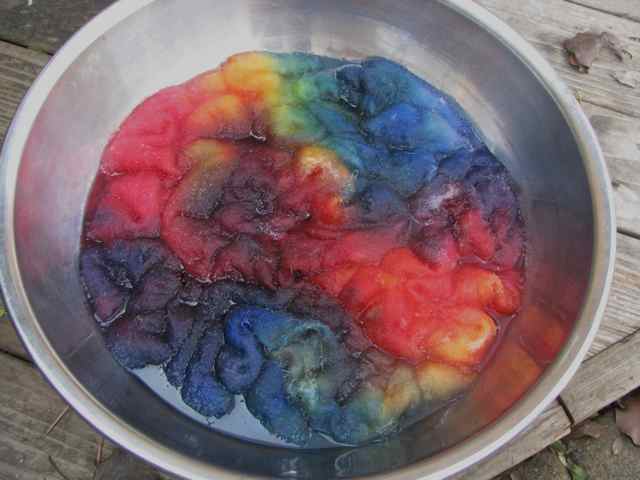
Mixing to produce green, purple, and orange

Let the roving soup sit on the stove until all the dye is absorbed into the roving. Like all things good, it takes a little doing before you’re going to feel like you’ve got it! Take the dyepot off the heat and let it cool down naturally. Once you can put your hands into the water, then rinse the roving a few times with the same temperature of water. You are rinsing out any unabsorbed dye, and the vinegar.
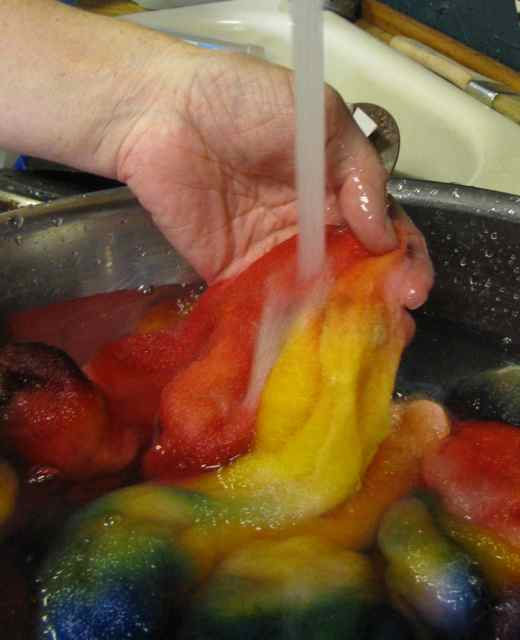
Rinsing the roving

Cooling and rinsing the roving is a S L O W process, and you should not be eager to hurry it up, or you can end up “shocking” the wool into felt!  Once the roving is very cool, you can put it in the spin cycle of your washer (on cold!) to remove excess water. Then air dry.

Air-drying the roving outside

Understanding “Dyed-in-the-wool”

Ahhh! I get it! Dyeing the wool before it is spun (i.e., dyed-in-the-wool) is the best way to ensure the color doesn’t fade once the wool is spun into yarn or thread, and then fashioned into a garment worn around town. The literal meaning of the phrase is simply a description of when the dye is added.

The phrase has evolved over time to mean something metaphorical as well. We use this expression “dyed-in-the-wool” to indicate a person who is committed to an ideal so deeply that it has become a permanent part of their being, as if they had been “dyed” that way prior to being “formed.” For example, I would say, “My dear Arabella is a dyed-in-the-wool romantic.”

Here, Arabella is rinsing some Corriedale roving that she dyed while it was “in the wool.”

Corriedale "dyed-in-the-wool"

I have been anxious to get my hands into the dye pot, and finally had opportunity at Arabella’s. She had received a 3-lb bump of lovely Corriedale, and shared a generous portion with me as a birthday present.

A “bump” is simply a bunch of roving, usually 1 to 3 pounds in weight.

A "bump" from a lovely Corriedale sheep


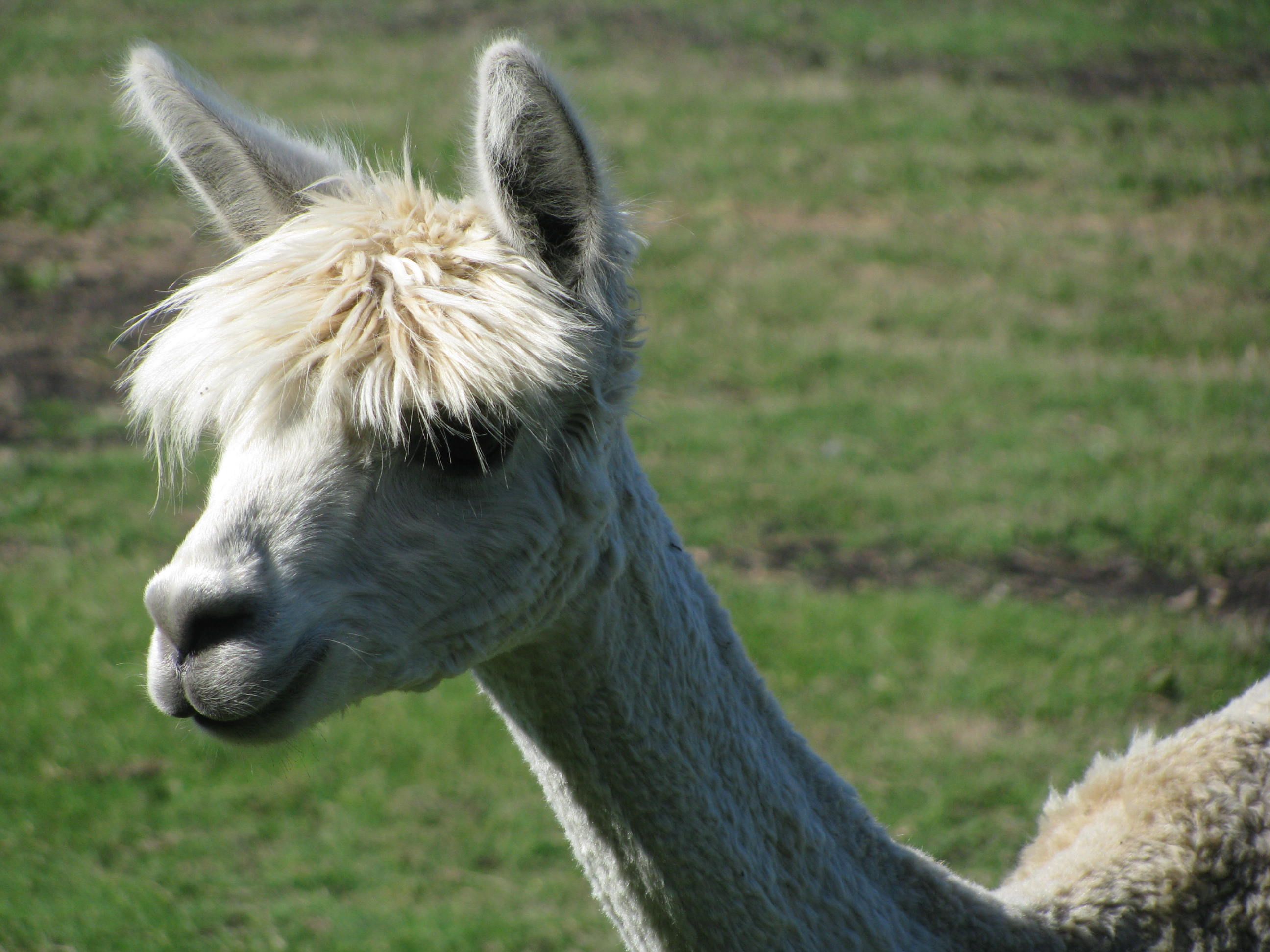
Here is what our lovely and generous sheep might have looked like when the wool was still a part of him!

Truly "in-the-wool!"

Gorgeous and generous sheep! They have been supplying us with fiber for our clothes, blankets, coverlets, coats and carpets for centuries!

Spinning Tips: Camel | International Fleeces

Spinning Tips: Camel | International Fleeces.

Check out International Fleece’s blog post on spinning camel fiber! Talia says camel fiber is 1/2 the price of cashmere, yet as soft with a micron count of 15-22; cashmere falls in the micron range of 14-18.5.

What’s a micron count?

Basically, micron count is a way to measure the quality of fineness or coarseness of fiber. A micron is equal to 1/25400th of an inch, or about a millionth of a meter! Special lab equipment is used to measure the actual diameter of each fiber in these tiny fractions. The lower the number, the softer and finer the quality of the fiber.

Click through to this brief article from bellaOnline about the three grading systems of fiber.

Did you know that the finest cashmere comes from the underbelly and throat of Kashmir goats primarily raised in Mongolia, Tibet, India and China? Lesser grade cashmere (thicker in micron count, and also shorter in length) comes from the Kashmir goat’s back and legs. It is said to take four years for one goat to shed enough wool to make just one sweater! No wonder it is so pricey!

Watch out once you start spinning luxury fibers such as alpaca and mohair. The incredible feel of the fibers in your hands is completely addicting, and soon you’ll be panting after some cashmere…so I am thrilled to hear Talia’s explanation that camel fiber is half the cost but in the same range as cashmere. More luxury fiber for less money!

You can find out more about these incredible fibers at the Cashmere and Camel Hair Manufacturers Institute (CCMI).

But you simply must go to Talia’s site to see the GORGEOUS luxury fibers she has available, especially the baby camel and bleached tussah silk blend. Oh my goodness, I just want to eat it!


This Crochet Pattern Looks a lot like Naalbinding

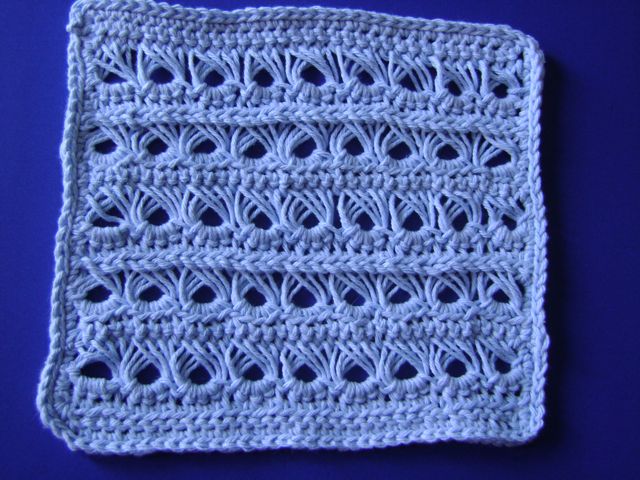
My mom sent me this picture of a very cute dishcloth she had crocheted. The pattern looks remarkably like ancient naalbinding, don’t you think?

Lacy Crochet Pattern for dishcloth

Here’s another picture up close:

Notice the loops

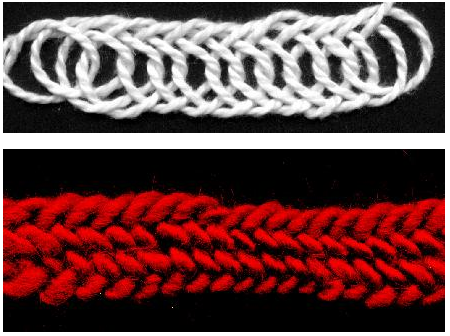
Now compare the above image to our samples of ancient naalbinding:

Notice the loops!

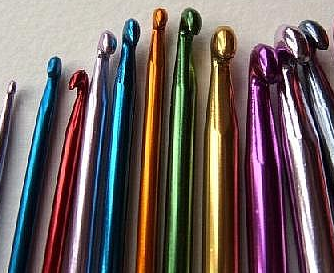
It makes sense, really. Naalbinding is perhaps the most ancient form of creating garments from yarn. The craft utilizes a large-eyed needle, which could easily have “morphed” into a crochet hook; both arts pull yarn through loops to create intricate and beautiful patterns.

Compare to Naalbinding Needles

What do you think?

“Incurable Whirling Disease”

Over The Rhine — if you haven’t met them yet, go introduce yourself; they are quite friendly, and extremely talented.

Exit

I have to leave the city now, she said,
Or dash my soul against my will instead.

I do not wish to have the quiet part of me
That once could rest (the part
That could just be) tossed
Aside and left somewhere
For dead.

Tonight it seems to me
That what some friends call energy
Is nothing more than a phenomenon of nature known as
“Incurable Whirling Disease.”

Please, take me far from here, she said,
The buildings sting and echo
With the fumy cries of yellowjacket cars.

I took her hand in mine and said,
I’m thinking of a place now
Where I used to have to tell myself
Aloud,
Those are not clouds,
They’re stars.

Copyright 2007, Linford Detweiler


Gains and Losses

pilgrim oil bottle
At Plimoth Plantation: A Moment of Clarity photo by Teresa Day

Last summer while working in Plymouth, Mass., I visited Plimoth Plantation, a living history museum set up as it would have been in the year 1629. I walked into one of the tiny Pilgrim cabins and saw the above, pretty much exactly as you see it here. I entered through the door just as the sun was pouring into the otherwise darkened cabin through the narrow chimney shaft, focusing the concentrated light on this small bottle of oil. So striking!

I’ve thought of this image many times over the last eight months or so since I took this picture. The thoughts generally focus on the question of gains and losses…since 1629, we’ve gained so much. A nation! Democracy! Medicine, technology, science…so much! I wonder why I keep returning to the other side of the coin (so to speak)–what have we lost?

We’ve lost the pace of peace, to be sure. All of our modernity, each item eagerly trumpeted as “the latest and greatest time-saving device” has not given us more time at all. As we have regulated all that used to regulate us–harvest, seasons, night and day–we’ve removed the natural barriers that kept us separate from the now constant-fast pace at which we hurtle through the days.

We’ve gained medicine, but lost health through our demand for processed foods and our unwillingness to unplug and slow down. Even when the doctor says to us specifically, “You have to reduce the stress in your life, or you will have a heart attack,” we don’t really believe him.

Nostalgia can be a dangerous drug. I want to be careful not to pine for what’s past as a retro-version of “the grass is always greener on the other side of the fence.”

In a sense, though, that IS what we do with our present and future–striving forward with technology and other “improvements.”  Once I get a SmartPhone, I can keep up with email when I’m in the carpool line or waiting at the post office; once I get and iPad and subscribe to the newest airplane wireless technology, I can stay in contact with the office even while I’m in the air; once I get the new 2011 Ford, I won’t even have to parallel park by myself! Once I get…

How do we break the cycle?


The Spinning Universe: 2010 in review

WOW! WordPress.com sent me this information today about this blog and its visitors, namely YOU. They’ve been keeping track for us, and basically, “we did good!”

The stats helper monkeys at WordPress.com mulled over how this blog did in 2010, and here’s a high level summary of its overall blog health:

Healthy blog!

The Blog-Health-o-Meter™ reads Wow.

Crunchy numbers

Featured image

A Boeing 747-400 passenger jet can hold 416 passengers. This blog was viewed about 2,300 times in 2010. That’s about 6 full 747s.


In 2010, there were 47 new posts, not bad for the first year! There were 215 pictures uploaded, taking up a total of 75mb. That’s about 4 pictures per week.

The busiest day of the year was June 3rd with 103 views. The most popular post that day was Photo Credits.

Where did they come from?

The top referring sites in 2010 were jacobsreward.blogspot.com, facebook.com, mail.yahoo.com, Google Reader, and terrificfibers.blogspot.com.

Some visitors came searching, mostly for ancient egyptian tools, spinning blog, naalebinding, ancient spindle, and drop spindle history.

Attractions in 2010

These are the posts and pages that got the most views in 2010.

1

Photo Credits April 2010
1 comment

2

Ancient Spindles May 2010
5 comments

3

History Has Been Woven by a Stick — The Astonishing Drop Spindle April 2010
6 comments

4

About April 2010
8 comments

5

Naalebinding, or Knotless Netting June 2010
3 comments

Warm, Useful, and Beautiful…From Wool to Blanket

The mohair is the shiny, thicker single. The merino is the softer, fuzzier single.

Ta da!  The process still works! Take some beautiful, soft white wool from a merino sheep and some shiny, slick gorgeous white mohair from a goat, spin singles of each, and then ply them together for a lovely length of textured and interesting yarn.

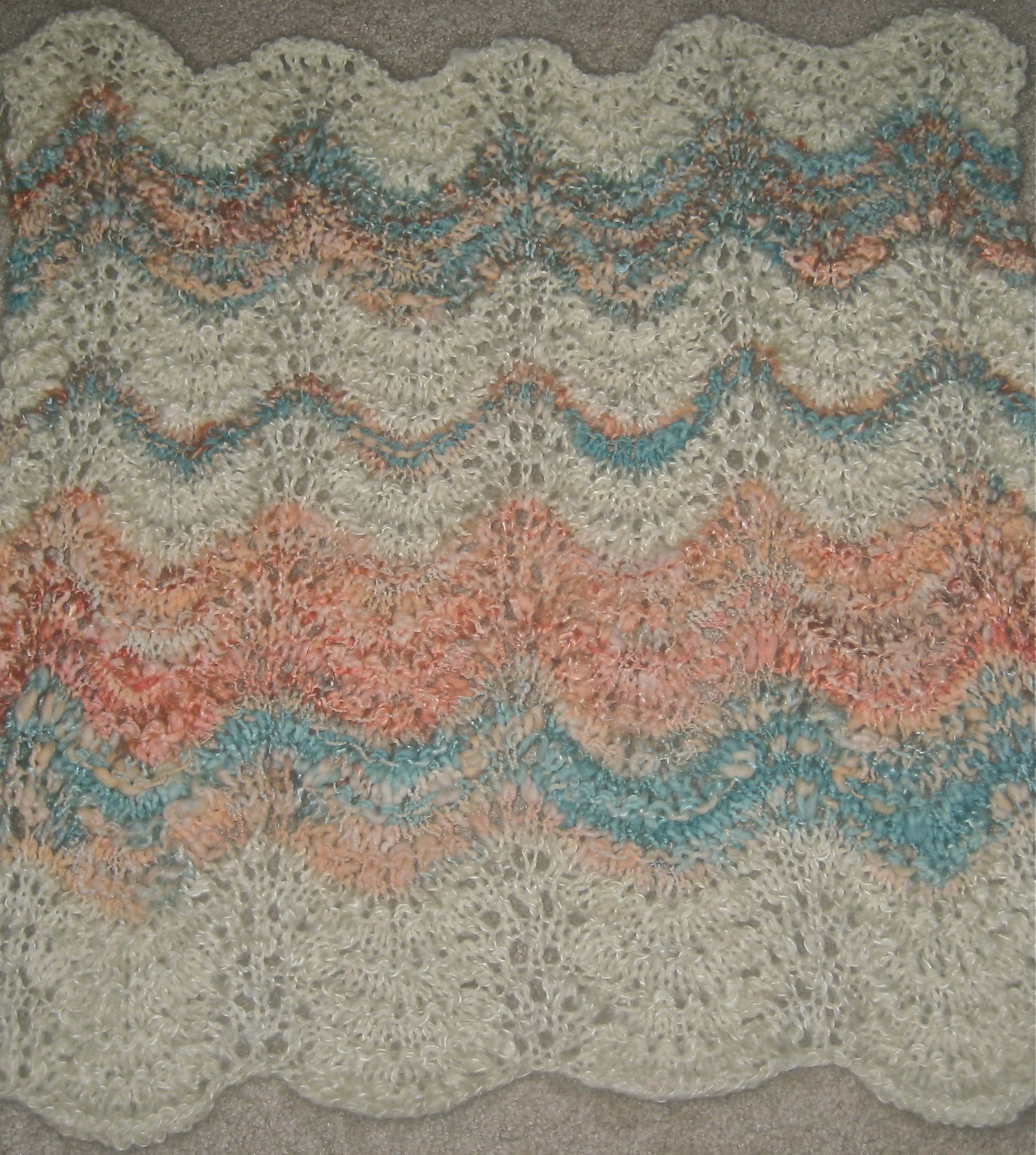
Using US 10 (or larger) needles, knit with a pattern from f.pea for a baby heirloom blanket with a lovely scalloped edge. Add some color–in this case, a skein dyed aqua and salmon from Arabella, handspun thick and thin for extra texture and interest. Keep knitting–in airports, in the car, on lovely evenings at home, to avoid housework, when you should be working, etc.

Functional Art-a simply beautiful blanket

Bind off (loosely!) whenever you want to, or when you run out of handspun yarn. You have now participated in the thousands-year-old ancient collective of outfitting your family with necessary material items.

Archeologists seemed surprised to find intricate beauty when they uncover textiles (or art) from thousands upon thousands of years ago. Their surprise is odd to me–because as long as we have been human, we have infused our material objects with artistic beauty and creativity. This is what it means to BE human.

Useful...and beautiful!

I like it, I like it!


If you LIKE it, SHOW it!

Posting a comment on a blog is a BIG commitment, in my opinion. It “puts me out there”…on the WORLD WIDE WEB, and that’s intimidating, for me and for most other people.  Which is why I am so happy WordPress has added the “like” feature at the end of every post. Clicking the LIKE button is much less of a commitment than commenting, while still allowing me the opportunity to support the post and pass positive feedback to the writer.

So look for the LIKE button at the end of every Spinning Universe post, and if you like the post, show it!  To see the “like” button, you have to click on the Post Title and then look to the bottom left of the post.