Something Else that Spins!

I started this blog 4 years ago to chronicle a journey though the spinning universe … my first post said this:

“Everything in our universe spins, from the tiniest of atoms to the mightiest of planets. Everything spins. Is this why there is so much peace to be found in spinning wool into yarn? In the act of spinning, are we emulating the Almighty’s act of creating and sustaining?”

I suppose, having had those intense feelings about spinning yarn, it is no surprise that I have now found even more peace and contentment in another act of spinning … making pots from clay on a potter’s wheel.
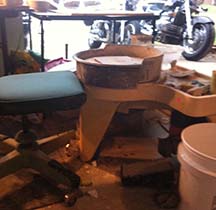
Potter's Wheel
My Potter’s Wheel


Clay is yet another natural substance, like wool, that demonstrates the glory and grandeur of our Creator. It’s very nature and molecular structure (more about that later) makes it the perfect raw material for constructing pots and vessels–just like wool contains within its structure the perfect characteristics for making yarn and fabrics.

First pots are much like first yarns —  uneven and somewhat wobbly, with lots of room for improvement! Arabella’s sage advice about spinning wool — “Good, you understand the basics. Now all you need is time at the wheel. Nothing else can teach you what you need” — also holds true for the potter’s wheel. The only thing that improves first pots is the continuous act of making second pots, third pots, fourth pots and so on.

The journey continues!


More Thoughts on Gains and Losses

I often think and sometimes write about gains and losses. In my life, globally, as God’s people, and even across the breadth of human history. Maybe especially across the breadth of human history, and specifically post-Industrial Revolution, when oh so many things have radically changed.

I suppose, as one who engages in centuries-old handcrafts, it’s only natural to compare the ancient and the modern. In any case, I just spent a wonderful weekend of creativity and learning at Mary Berry’s Fiber Retreat, and the whole experience brought me once again to these thoughts of gains and losses.

While I am quite glad that spinning wool for yarn and thread is my hobby and not a daily necessity (gain!), the weekend reminded me of the need to purposefully seek out groups that nurture us and foster excitement to learn and create. We can be so isolated in our lives (loss!), and the handcrafts that used to be so very necessary for survival and function are all automated now. Come to think of it, not just handcrafts, but so many other vocations have all been industrialized–from barrel-making to horse-shoeing to iron forging to silver smithing …the list could go on and on.

It’s the slow leaching out of daily creative efforts and the benefits we lose when that happens that gets me. And I do mean slow–such that we might not even notice. The progression has a frightening end, as we are now witness to and a part of — the elimination of the arts from school curriculum and the resulting general neglect of creativity and artistic expression. Which reminds me. Go see The Monuments Men, the WWII movie about the art scholars/architects who became soldiers and went to Europe to protect and restore stolen art. During the last year of the war, they recovered and then returned over 5 million pieces of art that had been stolen by Hitler and the Nazis. This movie will remind you how important art is to the world and to each of us.


Spinning = Happiness

My, my, my … how the time does get away. Life intervenes with plans … and even hopes and dreams. The necessity of earning a paycheck often takes up the time we romantics would rather spend spinning, knitting, creating, or otherwise engaging in activities for which we do not get paid. Thankfully, we have friends who can drag us back into the worlds we love!

Arabella encouraged me to go with her to Mary Berry’s Fiber Retreat over Valentine’s weekend. I am so happy that I went! The entire experience was such a reminder how much I need creative input into my life — and I believe this is true for all of us, whether we realize it or not. It can become difficult to set aside the time, but the peace that a creative experience can bring into your life is so worth the effort.

various fibers for spinning
All happily spun during the fiber weekend


I LOVE spinning! But I haven’t done much of it in the last two years. The weekend was an immersion in luxurious and delicious fiber–so many types of wool, silk, camel, alpaca–it felt so good to get them running through my hands again. The retreat also included a multitude of workshops on knitting techniques, spinning, weaving and even dyeing. It was a lovely group (I think around 90 women) with knitting needles, spinning wheels and portable looms.

I was able to spin this gorgeous teal skein (top of pic) that I purchased from Christine, who owns Spinning Straw into Gold. It is a 50/50 blend of silk and a material called tencel, which is fascinating! Tencel is a fiber made from wood pulp, it absorbs dye beautifully, blends well with others, has natural breath-ability like cotton but can absorb a lot more moisture, AND it makes beautiful yarn!

I was also able to finish spinning the fabulous Jacob wool that I got from Cindy’s farm (Jacob’s Reward), and a wonderful art batt that Arabella had made.

The silk/tencel was wonderful to spin!

silk and tencil batt
Spinning silk tencel blend

My mom’s blog is great! You might see where I get some of my peculiarities … and wonderings about the world….

Hill Country Cottage Gardener's avatarHill Country Cottage Gardener

“Beauty is as beauty does.” This was one of my mother’s favorite sayings–she had a million! I heard this one often growing up in the ‘50s, whenever she didn’t like what I was doing. If I wanted to be beautiful (like MM?), then I’d better “straighten up & fly right” (another one of her favorites).

Image

There is great wisdom in the idea that our outer surroundings are a reflection of our inner selves. But as a pragmatist, I’m more interested in the reverse: how our inner selves reflect our environment. Most of us are more consciously aware of our environment than our inner selves, so let’s create beauty in our gardens and our homes and expect that inner beauty will follow.

Image

If you are not already on Pinterest, you need to get on the waiting list today.  Or, if you have a friend—or a daughter—who is already a Pinner…

View original post 76 more words

The Creative Journey

Creativity is a fascinating concept. Once unleashed, you don’t know where it might take you. I’ve been fortunate to bear witness to my mom’s amazing creative journey since her retirement from teaching. I wrote about my mom’s creativity a couple years ago when I started this blog. I commented on the way being in her house  in the hill country makes me feel, because her artistic expression is everywhere. Read this post and you’ll see what I mean.

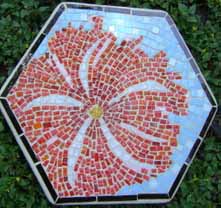
Since she retired, she’s been able to turn her attention full-time to her artistry. Her journey has fascinated and inspired me. She started making mosaic art pieces to place in her garden. It’s wonderful! Here’s one of her amazing stepping stones:

Tropical Flower
Gorgeous in the garden

Then she started making “waterers” for the garden–fabulous dishes that could supply water to the garden creatures:

Cactus Waterer
Drink!

Even she didn’t know that she was only beginning to discover her artistry. She bought a kiln (yes!) and started creating “Cottage Tiles” in her workshop, grouting them mosaic-style onto pots. Her work is original and inspiring to me, as I am on my own creative journey.

The Original Cottage Pot
The original cottage pot!
Turquoise Cottage Pot

REALLY Old Designer Fabrics

A TIME magazine article, Science: Cave Cache, published Monday, April 8, 1985, describes some astonishing artifacts found in a cave in Israel, and dated around 9,000 years ago from today (give or take several hundred years). The article says that in addition to the oldest painted mask ever found, the artifacts include:

“…basket and box fragments made of woven rushes waterproofed with asphalt, delicate thumbnail-size human heads and a rodent figurine, carved wood and bone tools, clay, stone and wooden beads and a human skull adorned with asphalt. Perhaps most remarkable are the fabrics, which are woven in eleven intricate designs, some resembling knotted macrame, others fine mesh.” (italics added)

In a previous post, I described a tomb wall-painting found at Beni Hasan in Egypt, dated around 2000 BC, that depicts at least two weavers and a spinner in great detail.  That’s old!!  But the remnants described above date 5,000 years earlier than those tomb wall paintings. We are now stepping so far back into the past that it is fuzzy and mysterious. Who really knows what was happening in 8,000 BC?  It is precisely at the point of “fuzzy” and “mysterious” that our biases emerge. (There’s lots of room for MSU.) For many scientists and archeologists, “primitive” and “intricately designed” just don’t go together, and that interests me.

I thought of this assumed contradiction again as I read descriptions of Naalebinding as “primitive knitting.”  Primitive is most often used in a pejorative sense, implying not only from the fuzzy past, but also meaning “being little evolved, uncivilized, characterized by simplicity or crudity.”

You call this unsophisticated?

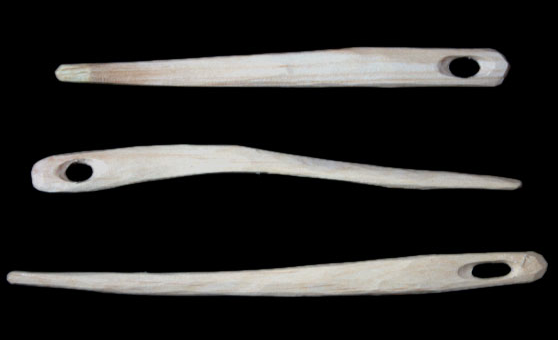
When I finally saw examples of Naalebinding, my first thought was “there’s NOTHING primitive about this!”  In fact, Naalbinding is a complicated series of intricate loops created with yarn threaded through a large needle’s eye, rather than looped with two straight needles, as we know knitting today. I will agree that this form of constructing garments is primitive, but only if we use THIS definition: primitive: “not derived by something else; basic.”

Naalbinding needles

Naalebinding is primitive in that it is the first form of knitting. Nothing about it is “crude, unevolved, uncivilized.” The technique produces quite lovely, smart, well-designed material objects such as dense, warm mittens, socks, hats, and sweaters. So, our 8,000 year-old ancestors not only made warm clothing to survive their winters, but they also expressed themselves creatively in design…isn’t creative expression the most basic way we are distinguished from animals?


Naalebinding, or Knotless Netting

We are definitely making progress, backward though it is, to find out more about the first fabric techniques. We’ve already found woven flax to be exceedingly ancient, and new finds keep pushing the date back (I’ve seen the date now at 6500 BC, and 32,000 BC!).

So where does that leave knitting?  The oldest techniques using needle and yarn are not what we know as knitting today on two needles; however, the variety, beauty, and usefulness of the objects made with the ancient technique of Naalebinding, make it no less a stunning hand craft. Watch this:

The Naalebinding stitches are quite simple, as the knit and purl stitch are in the knitting you might have just put down. And with the same astounding flexibility, the Naalebinding stitches can be endlessly turned into hundreds and hundreds of different patterns, edgings, and embellishments, due to our bottomless capacity for creative expression.

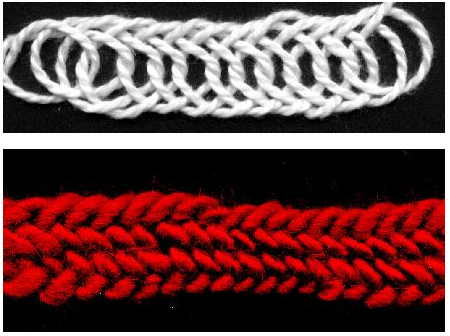
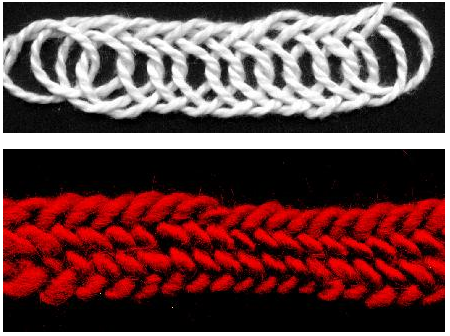
This picture is of a commonly used stitch. The top photo shows the stitches in white cotton, so that the shape stands out:

A basic naalebinding stitch, shown in cotton above, and bulky wool below

The bottom photo shows the beginning of an actual garment in bulky weight wool. Garments made from Naalebinding can be extremely dense and warm. When made from wool, the garments can then be felted for additional warmth.  Compare the above stitch to this more “complicated” stitch:

More complicated naalebinding stitch

You can begin to see that the variety in looping, crossing, and otherwise stitching with the flat needle and yarn can produce beautiful work in the hands of a skilled naalebinder! (Look here on Flickr at the Naalebinder Group! I knew the first garments probably included a purse!)

Also, there is a naalebinder group on Ravelry.


Stitch photos © 2001 Carolyn Priest-Dorman, used with copyright permission. http://www.cs.vassar.edu/~capriest/nalebind.html

Warp, Weft…What?

Wall painting in a tomb at Beni Hasan

Discovery has progressed through the last few centuries here on planet earth at an astounding gallop. Discovery within all of the various sciences, how motion impacts mass (a little something called gravity), telescopes and microscopes, antibiotics and surgical improvements, train, planes and automobiles, all the way up to the ever-improving and amazing iPhone. Somehow, we automatically think of progression as improvement. And often, it is.  The iPhone is a definite improvement over the telegram. Antibiotics are a definite improvement over dying.

But on rare occasions, some things start out great and don’t need much improvement, even after 10,000 years. The weaving of threads into a continuous fabric from which clothing is cut is one process that has not changed since the first time someone needed a shirt (or maybe it was a purse).  This illustration was found on a wall in an Egyptian tomb, depicting two weavers and a hand spinner, among other workers. Though we now process flax, spin it into threads, and weave it into linen cloth on machines, the individual steps in the process are remarkably the same.

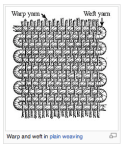
I think I can now finally understand the difference between warp and weft. The warp threads hang vertically from the top of the piece to the bottom of the piece, each as an individual strand.

The weft are made by the continuous “threading” of a long fiber under and over each of the hanging warp threads. In other words, the weft threads must be “set up” to hang vertically like a sort of stringed curtain. Then, a continuous thread is “woven” over and under, over and under, over and under each of the hanging weft threads, and a strong, continuous fabric is made.  Remember making construction paper place mats in grade school with this method?  Then you have practiced the ancient craft of weaving.

Turns out that weaving is waaaaaaayyyyy older a method of making clothing than knitting.  In fact, amazingly enough, knitting (as we know it today) is a fairly recent development.  (More on that another time, but you can get a jump from this great site learning about Naalebinding.)  The point here is that the first spun yarns and threads were not knitted, they were woven. And remember that every shred of thread woven into cloth up until the 12-14th centuries had been spun with a pair of human hands and a spindle.

The parts of the flax plant

I am getting closer to answering the question who made the first shirt? and it is beginning to look something like a linen garment, hand-woven from hand-spun flax using a hand spindle. Wool, it seems, joined in the fun much later, by several thousand years. Interestingly, linen has some of the same amazing properties as wool:  it absorbs water without feeling “wet” and can keep the wearer both warm and cool.

*Image used under GNU Free Documentation License from Wikipedia

“Material” Culture Tells the Story

I’m beginning to believe that history, like art, may be “in the eye of beholder.” And the further back in time we want to go, the more this is true.

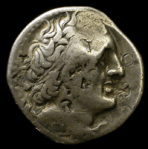
Face of Ptolemy II Philadelphos, 285-246 BC

I’m not talking about 100 years ago, or even 400 years ago, and maybe not even 2000 years ago, because we humans have a marvelous proclivity for recording ourselves. We’ve chiseled our likeness on every surface imaginable from a cave wall to a coin; written down our deepest thoughts, ideas, and dictums on animal skin parchment with the ink of berries; even encoded laws on stone and clay tablets. Something very deep inside all of us wants to be remembered.

As a result, the “material” objects left by past cultures really tell us a lot about what they believed about themselves and the world, and what they appreciated and valued. The problem is that the further back in time we go, the fewer of these objects we find, and putting together the “story” behind the material objects becomes something my sister calls MSU. That’s when the lack of facts surrounding an object or idea causes us to Make Stuff Up.  Right?

For example, I can “google” enough subjects surrounding 100 B.C. (About 24,600,000 results in 0.25 seconds) to construct a pretty good idea of  the state of life for the average Roman citizen, or even a barbarian or two wandering around outside the Empire. The basic stuff–the “material” goods of that time: fabrics, jewelry, pottery, tools, art–combined with all of the written works we have from this period

Woven Mummy Wrappings, Ptolemaic Eygypt 323-30 BC

gives us a clear picture….well, we don’t have to resort much to MSU.

But the farther back we want to go to know what we as ancient people ate, drank, worked at, created, wore, cursed over, prayed over, made for decoration or traded for goods, the fuzzier the picture gets. For me, it all sort of runs together with old World History lessons. Since I started spinning, however, I find myself driven to create a better picture of the first fabrics and who wore them, how they were made, and what choices were available. Or at least understand how much of the story we do know, and how much is someone else’s version of MSU–Making Stuff Up.

I am going to start with the timeline I found at The New World Encyclopedia because it specifically marks the find in Israel of the oldest textiles anyone has uncovered. TIME magazine’s description^ of the textiles says, “Perhaps most remarkable are the fabrics, which are woven in eleven intricate designs, some resembling knotted macrame, others fine mesh.” Stay Tuned…

^Read more: http://www.time.com/time/magazine/article/0,9171,965493,00.html#ixzz0rMf9uGDt

*Images from www.AncientResource.com. Click on image to go to website.