WordPress.com has added an easy feature (CLICK!) so you can keep up with The Spinning Universe’s Blog without even trying! Here’s a picture of the button (which is actually at the bottom of the page):
Cool New Sign Up Button--Click it down below
Scroll down to the bottom of this page to find the button, and click. You’ll receive each new post in an email. Thanks for reading!
WordPress.com has a new fun tool!! It’s called the ReBlog–and this allows me to repost on my blog something I love on someone else’s blog….like this……ooooohhhhh, lovely, lovely silk, handspun by SpaceCadet…..I am still a beginner, a spinner-in-training-using-simple-wool, but one day I hope to graduate to this sort of beautiful silk! This post is from her blog, SPACECADET CREATIONS:
Beautiful sunshine and a lovely warm day, I sat in the dappled shade of the trees and spun silk into heathered shades of blue, green, and purple. Just before I finished and came in, the wind picked up and the skies transformed from blazing and blue to an angry dark grey. A summer thunderstorm rolled in, and then ended as quickly as it started, leaving everything drenched but fresh again. Perfect! … Read More
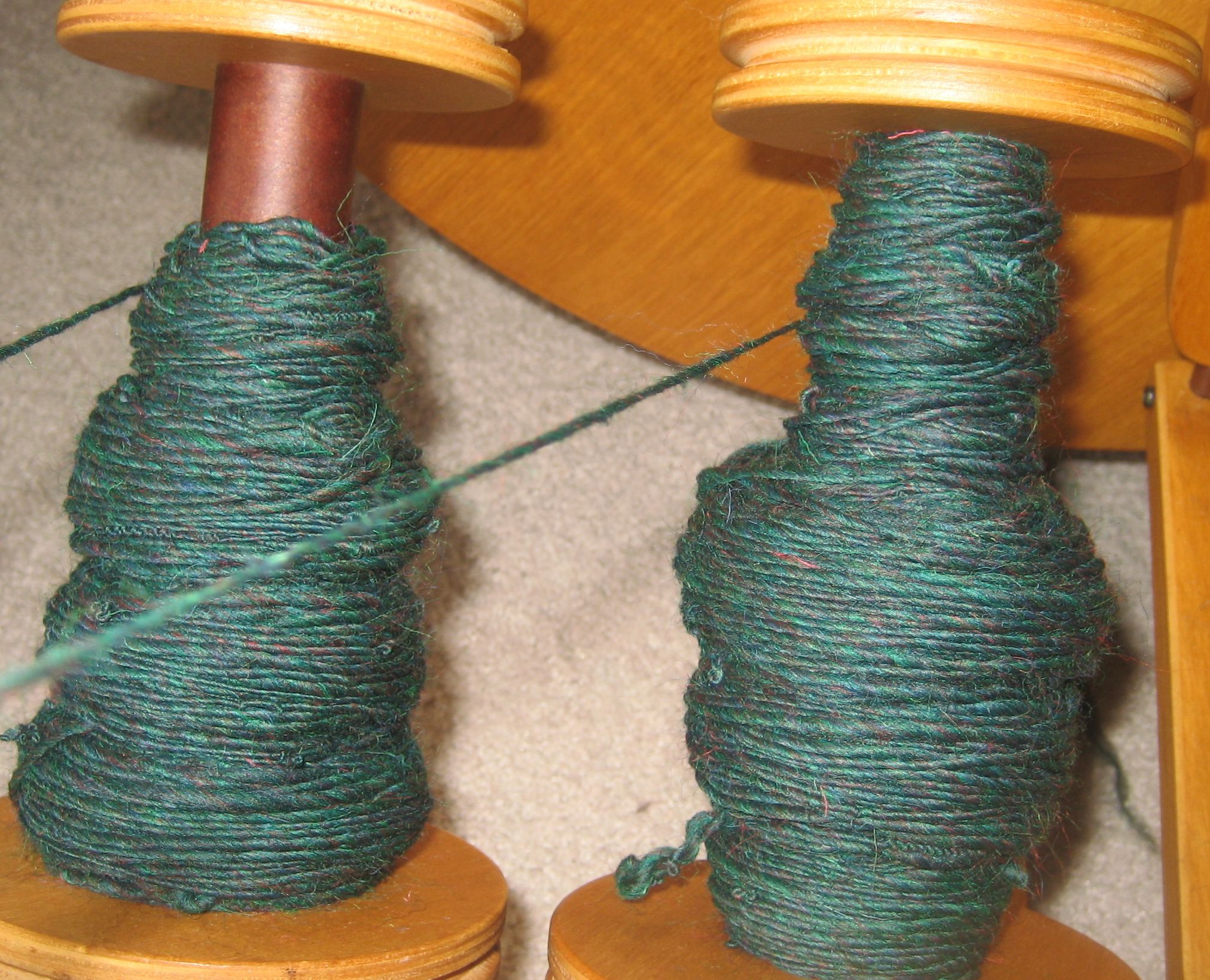
Lazy kates come in all shapes and sizes, depending on the brand. Many spinners make their own lazy kates from dowels and plywood. The lazy kate is simply a way to store bobbins holding spun yarn, or to help in plying the yarn.
Singles on bobbins held by lazy kate, ready for plying
So I am wondering what did Kate do to earn such a bad reputation? But I can’t find much information in the Google searches I have done. I did find a poem by a young British poet named Kirke White, writing in the early 1800’s, and who died tragically young. His poem, “Description of A Summer’s Eve” depicts what various individuals might be doing on a summer night, and in the poem’s second section, he writes:
“…And little Tom and roughish Kate are swinging on the meadow gate…Now they chat of various things…”
“…The mistress sees that lazy Kate, the happing coal on kitchen grate has laid–”
These lines are the oldest references (1809) I can find to Lazy Kate–though it might be just that the rhyming of the vowel sounds in “lazy” and “kate” are all that was needed to create this persona–poor Kate!
If any of you spinners out there know any other history of how Kate came to be so lazy, let us know!
From "Description of A Summer's Eve" Kirke White, 1809
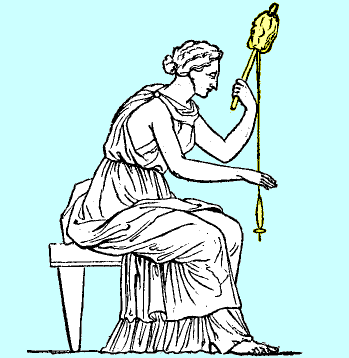
Roman woman spinning yarn with a distaff and drop spindle
It can be hard to grasp the fundamental importance of the act of spinning for our ancestors. Nobody currently alive in virtually any family in a developed nation has a memory of mother or grandmother spinning yarn for cloth to be used in their own household. Since people tend to gather in communities and develop trade, the practice of spinning your own yarn for cloth may have become a very distant memory. Even the Pilgrims arriving at Plymouth (1620) depended on the next ship to bring them cloth as they did not have room for spinning wheels (though wheels did arrive on subsequent ships).
Yet, daily spinning in homes was so important to the family for thousands upon thousands of years that the practice affected our very language. “Distaff” is an Old English word, originating at least as early as the 5th century in what is now England and southern Scotland. People, we are talking the 400’s here. We got Visigoths invading Italy, we got gladiators killing war prisoners and Christians, Augustine is writing The City of God, and women in homes are spinning, spinning, spinning the yarn for their household’s clothing.
Distaff & Fibers
Spinning was a daily task, unless you were very rich and bought your cloth or hired your spinners, or very poor, and couldn’t afford the wool or flax.
The word “distaff” is of course a replacement for whatever word represented the task in the previous language, because though the words may differ, the woman in the household spinning yarn remained a constant. She was just represented by different words as the cultures and their languages moved around her.
Twisting Spindle
All of that is to say that women and spinning were so synonymous, that between the 5th and 14th centuries (400 AD to 1300’s) distaff was used to represent female-ness, as we use maternal today. The distaff side of the family is the maternal side (the spear side of the family is the male side).
This representation of maternal stayed with our modern English language well into the 1700-1800’s.






 The Spinning Universe