c. 8000 B.C.E. – Evidence of flax cultivation in the Near East.[3]
c. 6500 B.C.E. – Approximate date of Naalebinding examples found in Nehal Hemar cave, Israel. This technique, which uses short separate lengths of thread, predated the invention of spinning (with its continuous lengths of thread) and requires that all of the as-yet unused thread be pulled through the loop in the sewn material.[4] This requires much greater skill than knitting in order to create a fine product.[5]
c. 6000 B.C.E. – Evidence of woven textiles used to wrap the dead at Çatalhöyük in Anatolia.[3]
c. 5000 B.C.E. – Production of linen cloth in Ancient Egypt, along with other bast fibers including rush, reed, palm, and papyrus.[6]
4200 B.C.E. – Date of Mesolithic examples of Naalebinding found in Denmark, marking spread of technology to Northern Europe.[7]
c. 3000 B.C.E. – Breeding of domesticated sheep with a wooly fleece rather than hair in the Near East.[3]
200 B.C.E. to 200 C.E. – Approximate date of earliest evidence of “Needle Knitting” in Peru, a form of Naalebinding that preceded local contact with the Spanish.[8]
Uh oh. I knew it would happen sooner or later. I have had about three days here by myself, with each child away on a different adventure, and no one needing anything from me. I thought I would be spinning for hours and hours, but the one thing that fascinates me more than actually spinning has captured me…researching about spinning!
It all started innocently enough…that curiosity got me wondering…What is the oldest textile that archaeologists have located? I mean, I just wanted to know when the first shirt was made. Really, that’s all.
But when my 20-year old daughter came into my bedroom yesterday, after my three days alone in the house, I’ll confess the room did look like that scene out of A Beautiful Mind, when John Nash’s wife walks into his office….(okay, there were some content differences….mathematical genius vs. curious spinning woman, left alone for three days…)
Scene from "A Beautiful Mind" taken from official movie website
But charts, diagrams, outlines, questions, and pages and pages of written notes were scattered all over my bed (my primary research spot), and a few pages with color-coded highlights were taped together and thumb-tacked to the wall. Josie walked in the room with a puzzled expression (Mom, have you lost your mind?). I found myself backpedaling to find a suitable explanation for all this…..what? all this…curiosity?
“Ummm…I had just been wondering about when people first made shirts?” ending with a question in my voice, hoping she’d accept the logic of one question leading to, well, all this.
Ah, the power of one question! When was the first shirt made? has taken me on a remarkable journey through the history of humanity, and the archeological, theological, scientific, and curious anomalies that accompany such a journey. (This whole line of questioning was begun after discovering the spinning wheel is a modern invention.)
Archeology is most fascinating–not only for what is dug up from the earth to tell us about people and their communities and habits–but also for the drama of pride, family feuds, hurt feelings, and ego of the scientists themselves, and their resultant actions. Like the famous Leakeys–the father, Louis, finds an astounding skull that might be the oldest human fossil….until young son Richard grows up and finds one that might be even older…and for 20 years, a dispute rages about the dates. Hmmmmm…
Or the scientist who made such bold claims about his find before they were verified, that his later embarrassment led him to keep the bones locked in a closet for many years, depriving the scientific community of the value they did hold. It’s riveting, truly.
Have I found the answer to my first question yet? No, I really haven’t. But I have discovered a bunch more questions….
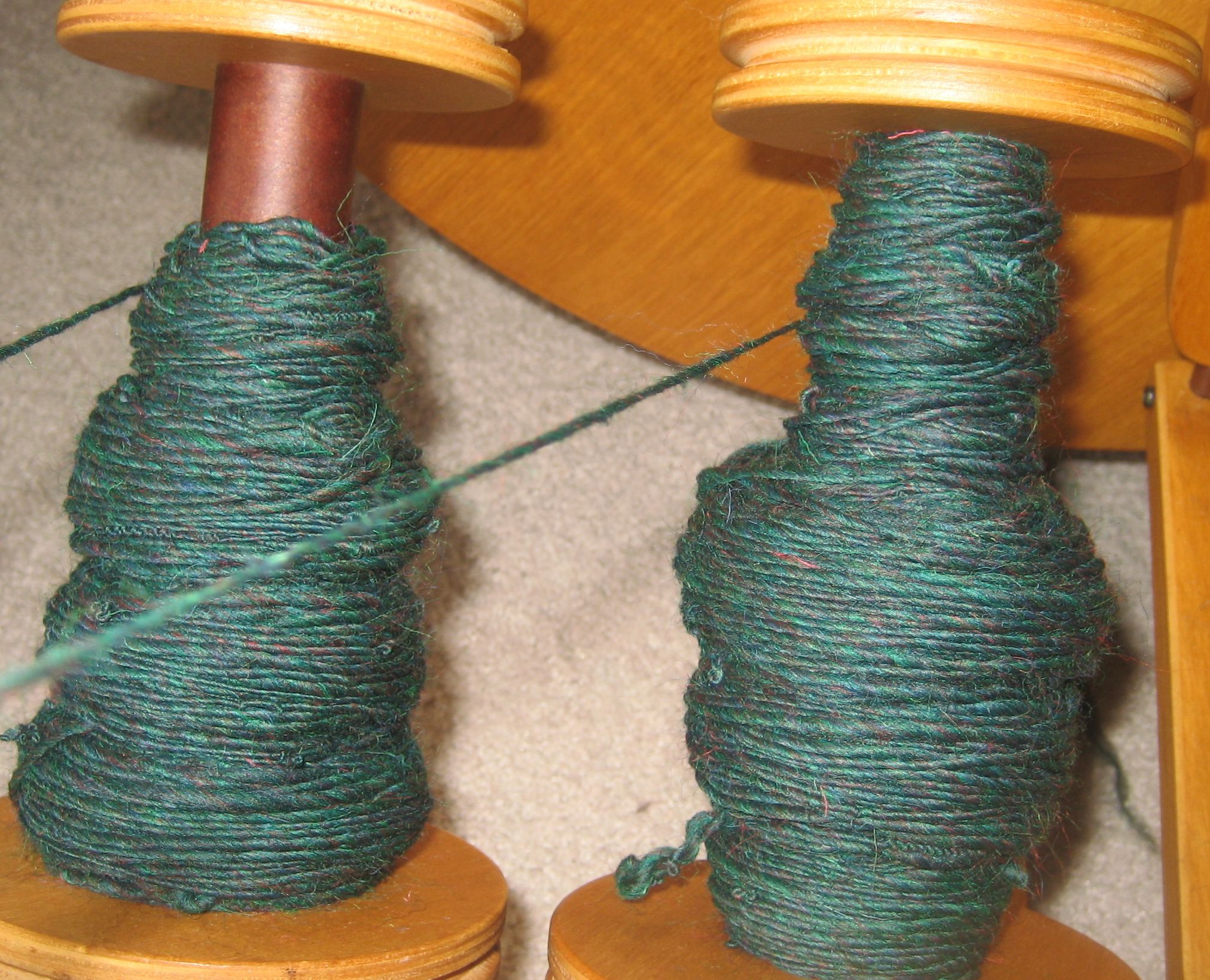
Lazy kates come in all shapes and sizes, depending on the brand. Many spinners make their own lazy kates from dowels and plywood. The lazy kate is simply a way to store bobbins holding spun yarn, or to help in plying the yarn.
Singles on bobbins held by lazy kate, ready for plying
So I am wondering what did Kate do to earn such a bad reputation? But I can’t find much information in the Google searches I have done. I did find a poem by a young British poet named Kirke White, writing in the early 1800’s, and who died tragically young. His poem, “Description of A Summer’s Eve” depicts what various individuals might be doing on a summer night, and in the poem’s second section, he writes:
“…And little Tom and roughish Kate are swinging on the meadow gate…Now they chat of various things…”
“…The mistress sees that lazy Kate, the happing coal on kitchen grate has laid–”
These lines are the oldest references (1809) I can find to Lazy Kate–though it might be just that the rhyming of the vowel sounds in “lazy” and “kate” are all that was needed to create this persona–poor Kate!
If any of you spinners out there know any other history of how Kate came to be so lazy, let us know!
From "Description of A Summer's Eve" Kirke White, 1809
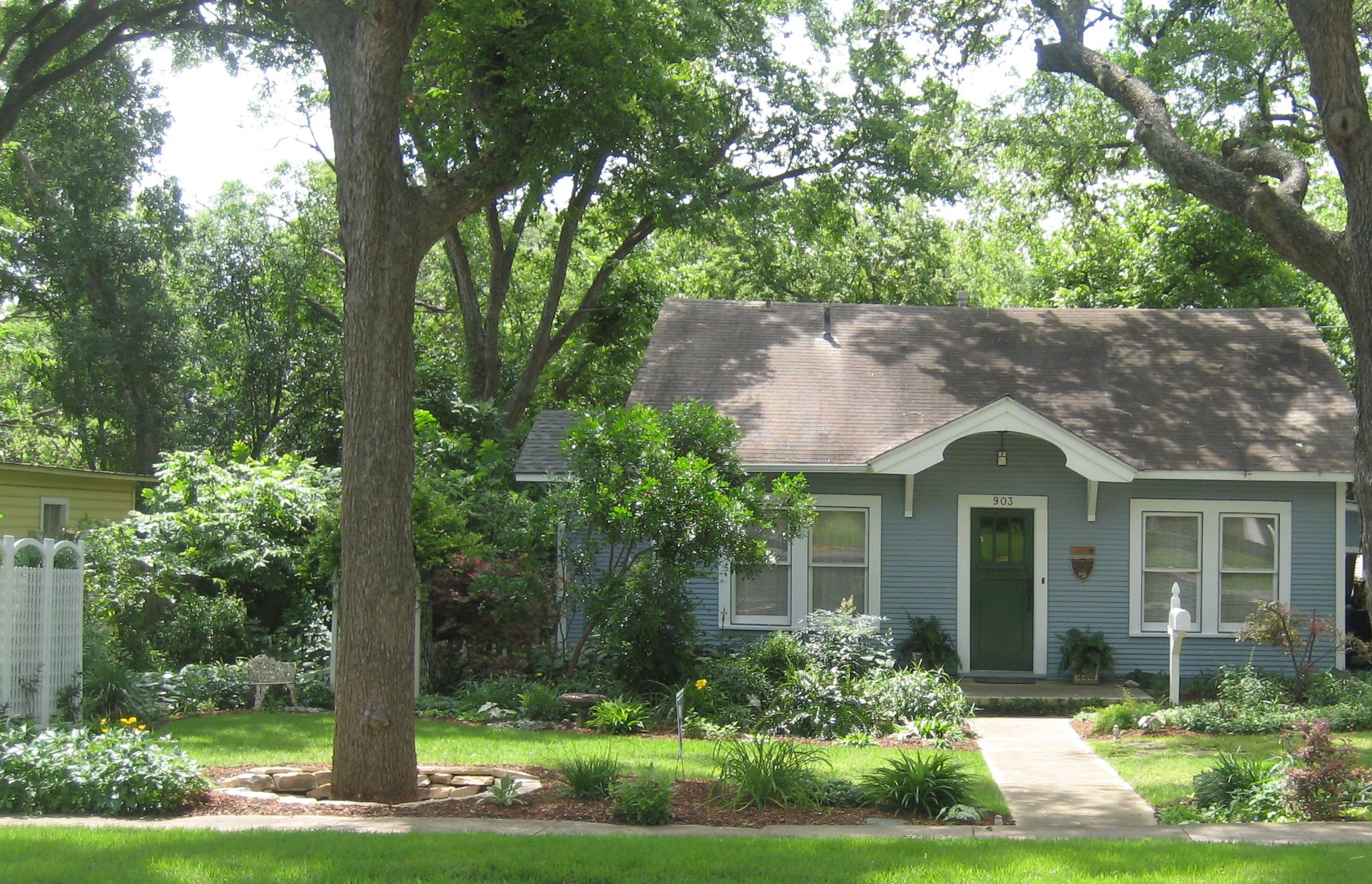
I love visiting my mom’s house in the beautiful Texas hill country. There seems to be a peace in the hill country all its own–the many clear rivers, the luscious greenery, interesting caves and hills and canyons–the area is a treasure. My mom’s house is a treasure too, a tiny 1911 cottage with a huge yard that she has completely transformed in the twelve or so years she’s lived there.
Mom's 1911 Cottage in the Texas Hill Country
I see now that my mom is truly an artist. She’s also a mom, and a professor, and a friend, and a colleague, and a writer, and a speaker. I respect and admire all those things about her. But one huge reason I like going to her house is to be in the middle of her artistic expression, and to feel the way it makes me feel. Engaged. Interested. Peaceful. Happy, even. Surrounded by beauty and art.
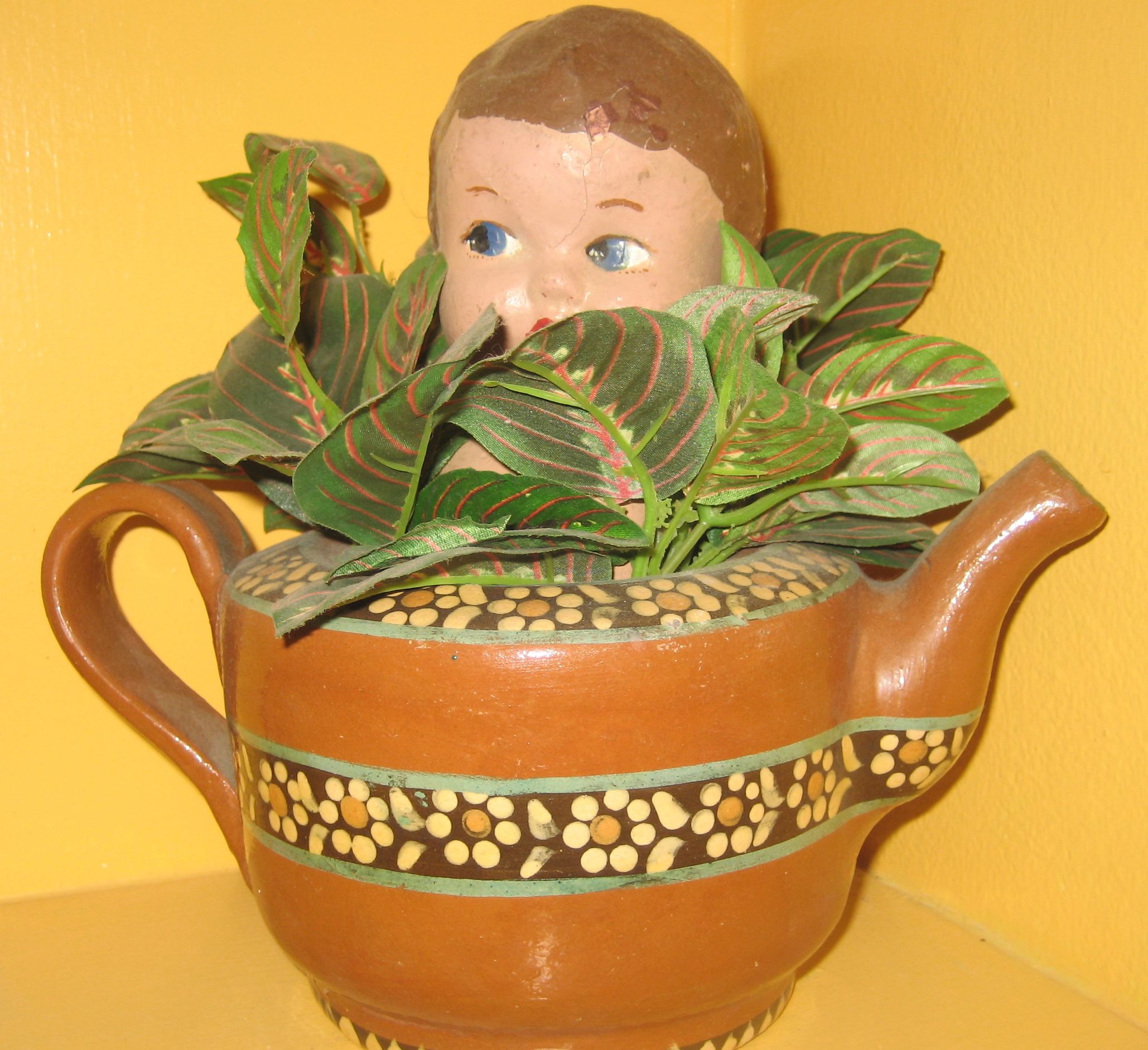
None of it is “museum art”. You won’t be impressed with famous names or even pieces that look like they should be in a museum. Her art is truly expressive, mostly folk art and functional art. I mean, she has an antique doll head on top of a plant in a teapot. Who does this? Well, she does, and it’s fabulous.
My Mom's Folk Art
On the long drive back to my home, I started thinking about how I feel in her house, and why I like her particular style so much. Maybe partly because she’s my mom, and I seem to have inherited her “quirky” gene. But I think it’s mainly because everything in her house feels intentional. Every beautiful or even strange object (like the doll’s head) is placed precisely where she wants it to be, with intent. This feels substantial to me, and I like it. It is artistry.
Functional art intrigues me very much because it represents the creative spirit in all of us (see Angus’ post about Art.) Shaker furniture may be the most recognized example of the best of functional art–pure beauty in its simple lines and curves, the best artistry and craftsmanship in its making, and an enduring statement about incorporating art and beauty into our daily mundane tasks. My mom has a lot of functional art in her home. The plastic cups we drink from are even artfully colorful in her exposed cabinets.
Exposed Cabinets
But there’s a reason they aren’t just plastic cups, but are instead colorful, textured, and perfect for the spot. The reason is because she’s an artist, and her home is her canvas.
I returned from a trip to Boston last night, and as I waited outside the terminal for my daughter to pick me up, I took out some knitting I had carried with me.
A mid-forties’ man walked by me and did a double-take. A huge grin spread over his face, and he said, “Now, that’s something you don’t see every day!” He nodded in my direction, and went on. He’s right, I thought. You really don’t see people with handcrafts in public much. Which of course got me thinking about a time when making your own garments was the only means you had of staying clothed. Now that’s a motivator!
The 41st Cottonwood Arts Festival was held this weekend in Richardson, TX–close enough to Dallas city line to be confused as Dallas–at the beautiful Cottonwood Park. Art folk from all over the country come to this event, and this year was another spectacular year with amazing art on display. There were something like 241 artists, and three caught my eye above all else. The first one was Gabe Leonard, www.GabeLeonard.com, with his Wild West paintings. His card says, “oil paintings of outlaws, musicians, & drunken poets.” Awesome. This guy is not painting your typical yellow rain slicker or your running horses. Go to his website–he paints what you’d recognize as “western,” but in a style that…hmmm…I just don’t know. Fabulous. You’ll have to go to his website. He also paints historical figures such as Lincoln, Hood, and Robert Johnson, but in a way you’ve never seen before!
The second artist, Hanan Ingel of Silver Mind had created the most stunning jewelry–rings, bracelets, earrings and necklaces that each featured an ancient coin–Greek, Roman, Byzantine, even a “widow’s mite” coin all from very early AD. Amazing!! You could be walking around right now with a ring with an inset bronze coin imprinted with the image of Constantine. Maybe a spinner in 324 parted with this hard-earned coin to purchase more wool!
The third artist, Tres Taylor, was my favorite of all three. His website says, “His subjects are usually monks, couples, and houses, but always the subjects are symbols of love.” His art is the best of folk art–using materials at hand (tar paper and house paint)–and creating images that make you stop and stare, truly invoking a sense of wonder and feel-good-ness.
Hats off to artists who are pursuing their art and creating beauty for us!
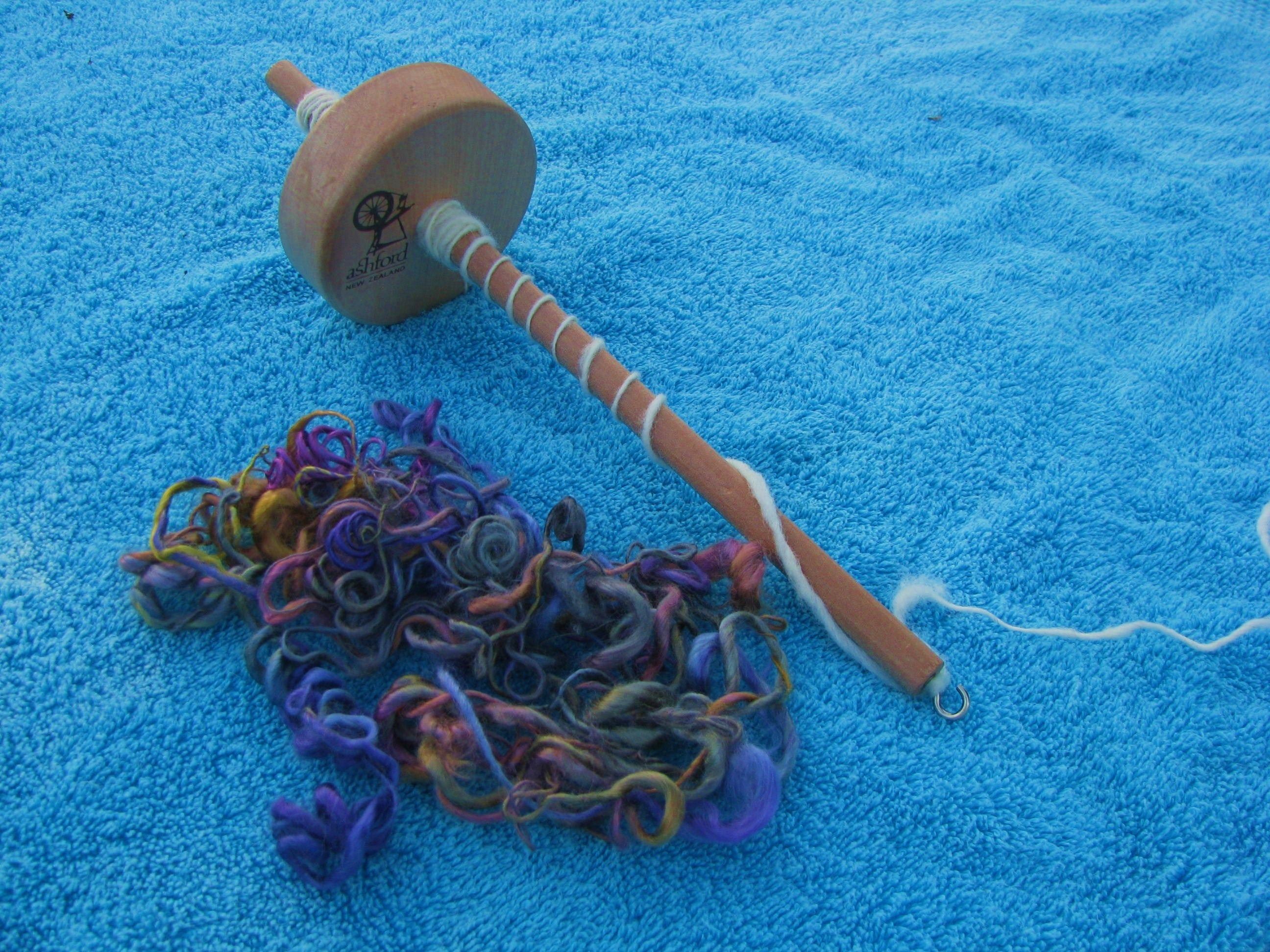
As mentioned in the previous post, I am completely flabbergasted by the importance of the drop spindle in over 10,000 years of human history. The spindle was the only tool for spinning threads and yarns to make everything on earth ever made from fabric or cloth, up until recent history (read more here about the history of the spinning wheel).
WOW! This is the tool that spun the world!
Here is a picture of a drop spindle and some beautifully dyed bamboo yarn that MonChere purchased as her first experiment into spinning.
She spun amazingly well, as I’ve hear that bamboo is not easily spun!
But now you can see how basic and simple the spindle is, and if you weren’t flabbergasted before, I hope you are now. Otherwise, you might be completely overtaken with the mundane-ness of buying your clothing at the store and need a shake up. Or you might be dead.
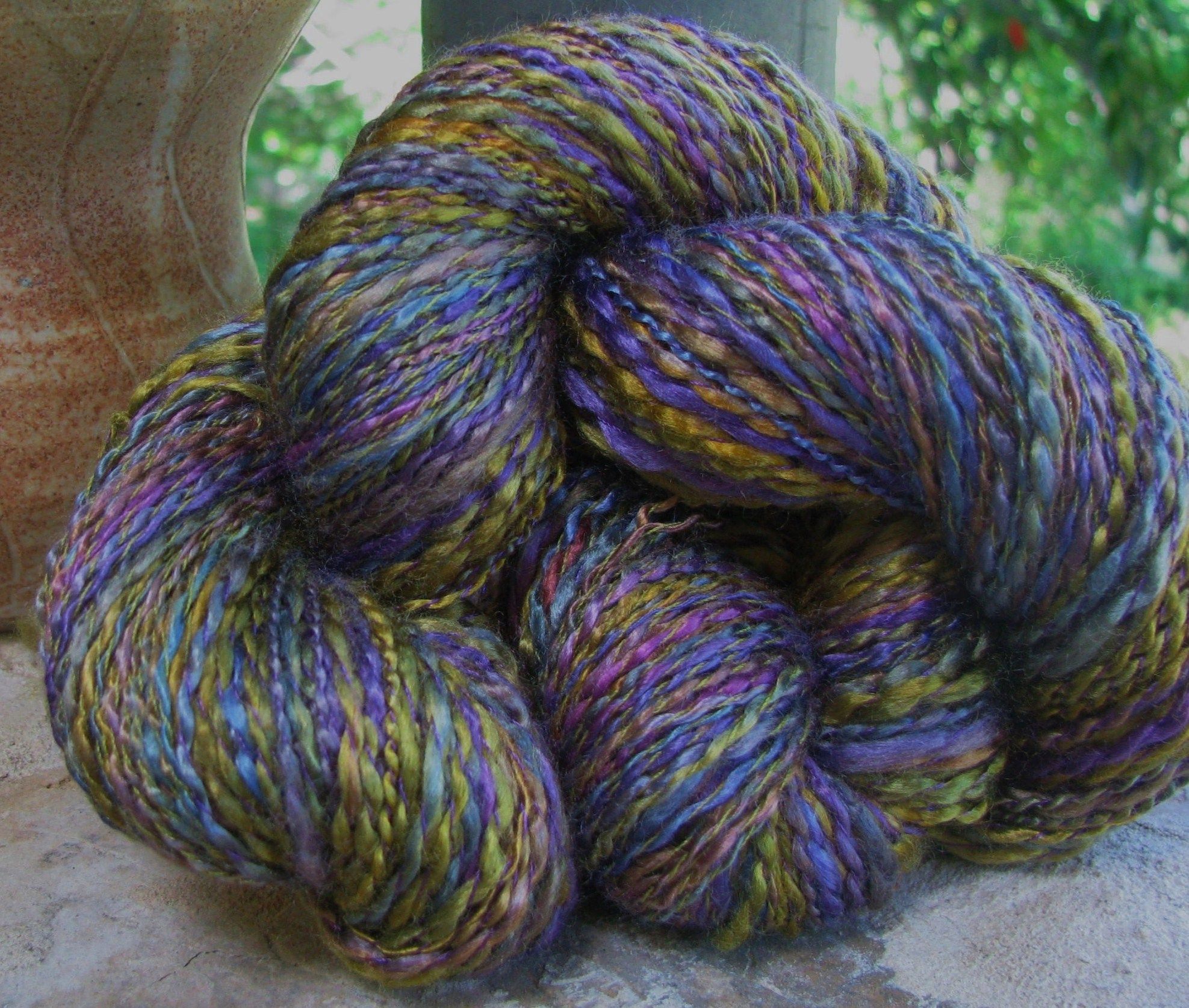
MonChere gave the unspun bamboo to Arabella to spin on her wheel, and here is the delightful result (Arabella is quite the spinner).
Because we live in a time when clothing is simply something we grab off a rack in a store, we’ve lost appreciation for what it takes to make fabric or cloth of any kind. We rarely think of it at all–unless we were raised in sewing homes, like me, where our mothers measured, pinned, and cut large batches of cloth into pieces they would sew into our tops, shorts and matching Easter dresses. Or maybe you’ve admired a period costume in a film and given a nod to the past ideas of spinning or whatever else it took to make such things. That was me. Until I started spinning myself. (Yes, it was only 2 weeks ago!)
My natural curiosity got to me and I started wondering about origins of spinning wheels, who invented what, and so forth. So I dove in to take a look, and I am simply flabbergasted at what I have discovered. Flabbergasted.
The spinning wheel itself is actually a very modern device, and used in only about 8% of the time that humanity has been wearing clothes and making cloth. The very first images and mentions of spinning wheels only date back a mere 760 years. Here are some key context points: The Magna Carta was established in 1212, Marco Polo was packing for China in 1271, and the Vikings were settling down and raising sheep instead of pillaging. (Okay, these things seem old, I’ll admit, especially compared to the latest version of MicroSoft Windows. But it’s only 800 years! We’ve been wearing clothes a lot longer than 800 years!!)
So, I next had to ask: What on earth was used prior to 1250, and the invention of the spinning wheel?
The fiber: animal wool or hair, fibrous plants such as reeds, bamboo & flax, and silk
The spinning tool: a spindle and a pair of hands
The fibers have stayed consistent throughout history and are an assortment of animal and plant fibers. A spindle is basically a stick (or bone or other hard material carved like a stick) upon which fiber is twirled to produce a “twist” while the fibers are also being slowly drawn apart. The fibers “twist” into yarn, and if they’ve first been “combed” in the same direction, the fibers “twist” even more easily. That is spinning in a nutshell. But what’s so astonishing is that for 11,200 years every piece of cloth or fabric or yarn or thread was produced by a pair of human hands on a stick.





 The Spinning Universe